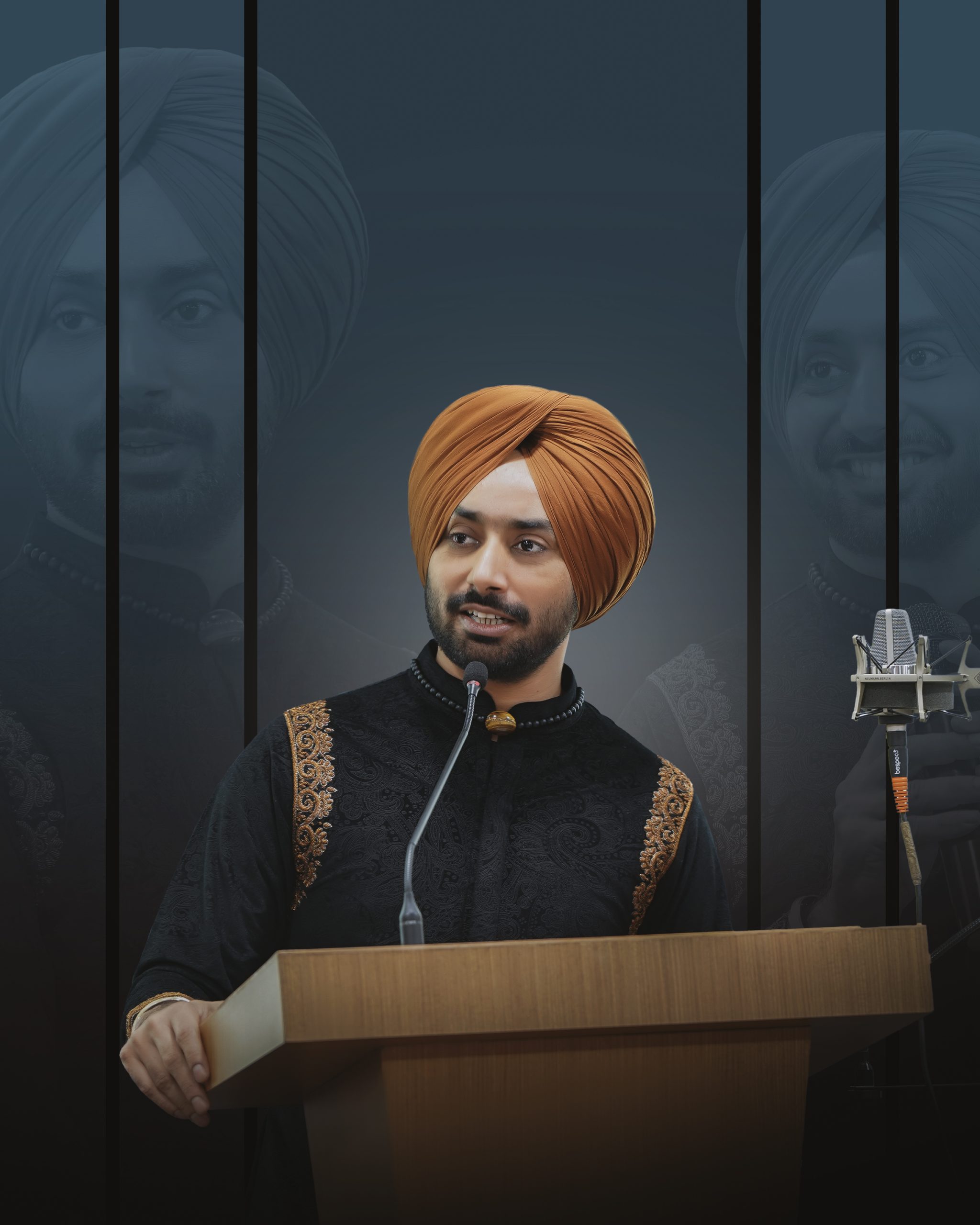
Dr. Satinder Sartaaj, the soulful poet, singer, and scholar who has carved a quiet yet profound place in the hearts of millions, recently brought audiences into the sacred stillness of Tabsara—a mehfil (poetic gathering) that was less a performance and more a meditation. Held in Chandigarh, this unique evening invited listeners into the intimate world of introspection, where every verse was a mirror and every silence, a doorway.
From Village Roots to Global Recognition
Born as Satinder Pal Singh in the small village of Bajrawar in Punjab’s Hoshiarpur district, Sartaaj’s early years were shaped by simplicity and soulful music. By the third grade, he was already performing in front of local audiences. But even as his fame grew, the core of who he was remained untouched by glamour. His journey is one of discipline, intellect, and an undying devotion to art.
He pursued a Bachelor’s degree in music, followed by a Sangeet Visharad in classical music, and later earned a Master’s, MPhil, and PhD in Sufi singing from Panjab University. He even studied Persian to understand Sufi texts in their original language. For six years, he taught music at the university, balancing academia with artistic exploration.
The Soul Behind the Crown
Sartaaj adopted his pen name, which means “crown,” during his college years—but his real crown lies in humility. If you ask him about success, he won’t mention awards or sold-out shows; he’ll speak about sincerity. He once said, “If I ever get a tattoo, it would say — Acceptance is the power.”
This one phrase encapsulates his philosophy: to accept feedback, to accept change, to accept oneself with all flaws and truths. It’s this acceptance that shaped Tabsara into something far more than just a poetic event.
‘Tabsara’ – The Inner Review
Tabsara, which translates to “The Self-Review,” opened with the delicate yet potent lines:
“Chalo tabsara kariye dil vich jo vi aa,
Is vich rose vi ne, is vich moh vi aa…”
With these verses, Sartaaj invited the audience to sit with their own truths. The atmosphere was gentle, stripped of grandeur, and heavy with emotion. This wasn’t performance for applause—it was poetry for presence.
In an age where most artists seek the spotlight, Sartaaj instead turns the light inward. He doesn’t command attention—he earns trust. And that trust was the quiet heartbeat of Tabsara.
Themes That Touched Every Soul
Throughout the evening, Sartaaj reflected on dreams that don’t let us sleep, the masks we wear, and the impossible task of ego-death:
“Sapna yeh aaya ke neend aa nahi rahi…”
(The dream came—but sleep did not follow)
“Chalo makhotay vi chaahide hunde ne…”
(Perhaps masks too, are necessary sometimes)
“Main nu manfi karna kehda saukha ae, jiunde jee hi marna kehda saukha ae…”
(What’s easy about undoing yourself? What’s easy about dying while still alive?)
These weren’t just poetic lines; they were revelations. They brought tears, stillness, laughter, and a feeling of homecoming to those who may have forgotten where they belonged.
‘Asin Gharon Bhajje’ – A Poem of Longing
Among the many highlights of the evening was the poem “Asin Gharon Bhajje…” (We ran away from home). It opened with:
“Asin gharon bhajje rukhan thalle behin nu ki,
Hawa shayad gaun nu kahe…”
This was not merely a poem—it was a haunting memory. A reflection on childhood, the simplicity of life under trees, and the modern disconnect from our roots. It struck a raw nerve. It reminded the audience that not all journeys are about moving forward; some are about returning.
A Unique Fusion of Mind and Melody
Sartaaj’s art is not rooted in the need to impress—it’s driven by the desire to connect. And it’s this very quality that separates him from the crowd. While others chase virality, Sartaaj chooses depth.
In Tabsara, his academic background and spiritual grounding came alive:
* He weaved Persian, Urdu, and Punjabi effortlessly.
* He didn’t just sing—he taught, gently and without ego.
* He created a shared space where intellect and emotion met, and where simplicity was sacred.
Not Just a Concert—A Communion
At Tabsara, the stage was not elevated, and neither was the artist. He sat among his audience—in thought, in feeling, in essence. And that is perhaps why the evening lingered far after the final verse.
This wasn’t a night of entertainment. It was a moment of communion. A slowing down of time. A reminder that reflection is resistance in a distracted world.
Legacy in Motion
From his breakthrough performance in Toronto to sold-out concerts at international venues, from playing Maharaja Duleep Singh in The Black Prince to creating some of the most profound Punjabi songs of this generation—Sartaaj’s journey has been vast. And yet, through it all, he remains deeply rooted in humility, language, and longing.
What Tabsara showed was that his greatest work may not be the albums, the films, or the awards—but his unwavering dedication to truth.
A Gentle Revolution
In a world drowning in performance, Tabsara was rebellion through stillness. It reminded everyone present that vulnerability is not weakness, that silence speaks, and that poetry can still heal.
Sartaaj doesn’t just write verses. He lives them.
He doesn’t just perform. He communes.
He doesn’t just sing. He listens.
And Tabsara was the embodiment of all that he is—crowned not by gold or glitter, but by grace.

Surjitt Sahani