
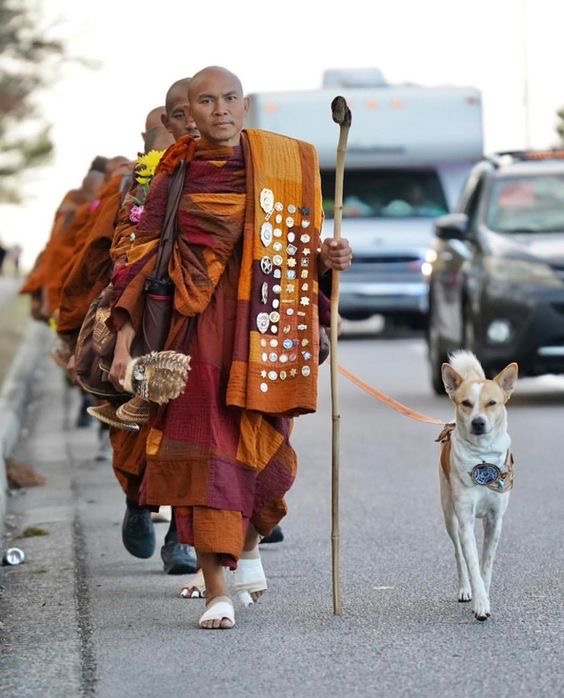
By Resham Sahani
In the quiet folds of a monastery where bells measure time more gently than clocks, where the day begins with breath and ends with gratitude, an unlikely resident found his home. He did not arrive robed in saffron, nor did he chant ancient syllables. He arrived with dusty paws, curious eyes, and a tail that wagged at the pace of wind in the neem trees.
His name is Aloka.
And he is an Indian Indie dog.
Not a breed that arrives with papers, pedigrees, or price tags. Not a dog chosen from a catalogue. Aloka is what India lovingly calls a desi dog—born of the land, shaped by its seasons, intelligent from survival, and beautiful without ever trying to be.
In a world that often overlooks the Indie dog for imported breeds with foreign names and glossy coats, Aloka quietly lives a life that feels like poetry. Among monks who have renounced the noise of the world, he became a gentle, living reminder of something they already knew:
That divinity often arrives without announcement. And sometimes, it arrives on four paws.
The Arrival
No one remembers exactly when Aloka first wandered into the monastery courtyard. Some say he followed the scent of food from the kitchen. Others believe he followed the sound of chanting. A few monks, smiling when asked, say he was always meant to be there.He did not bark or demand entry. He simply sat by the stone steps during evening prayer and watched.Monks are trained to observe without attachment, but there was something about the dog’s gaze—calm, alert, deeply present. Not hungry for attention, not fearful. Just there.
A bowl of water appeared near the steps the next day. Then some leftover rice. Then, without a formal decision ever being made, Aloka became part of the monastery.No ceremony. No announcement. Just quiet acceptance.
The Indie Dog: India’s Unsung Native
Aloka represents a lineage older than most of the structures humans build. Indian Indie dogs are among the oldest and most naturally evolved dogs in the world. They are not manufactured by selective breeding for appearance. They are shaped by climate, terrain, survival, and instinct.
They know how to read human expressions without being taught. They can survive heat, dust, rain, and uncertainty. They carry resilience in their bones and gentleness in their temperament.
And yet, in modern India, they are often ignored in favor of foreign breeds who struggle in the same weather that Indies are born for.
Aloka, with his short brown coat, alert ears, and intelligent eyes, carries this heritage quietly. No one in the monastery calls him “just a street dog.” They call him sevak—a silent server.
A Monk Without Vows
Every morning before the first bell rings, Aloka is awake.
He walks slowly along the stone corridors as if inspecting the dawn. He sits outside the prayer hall before anyone arrives. When the monks gather for meditation, he curls up near the entrance, head resting on his paws, eyes half-closed—not asleep, but aware.
He never interrupts. Never intrudes. When chanting begins, his breathing slows, matching the rhythm of the room. Visitors often ask in whispers, “Is he trained to do this?”
The monks smile. “No,” they say. “He simply knows how to be.” And perhaps that is the essence of meditation.
Lessons Without Language
Over time, Aloka became a teacher without ever intending to be one.
New disciples who struggled to sit still found their eyes drifting toward him. His stillness was not forced. It was natural, effortless. Watching him, they learned what no lecture could explain: peace is not achieved by trying. It is uncovered by being. Children who visited the monastery were drawn to him. He let them touch his ears, rest against his side, speak secrets into his fur. He never snapped, never retreated.
He had no concept of status. To him, a monk and a child were equal recipients of quiet affection. In a place devoted to dissolving ego, Aloka had never carried one.
The Shadow of Another Dog
Sometimes, in the afternoons when the sun softened and the monastery rested in silence, an elderly monk would sit beside Aloka and tell visitors a story.
A story about another dog.
A dog named Laika.
Long before Aloka found his way to the monastery, Laika had found her way into history. In 1957, a small stray dog from the streets of Moscow was chosen for a mission no human could undertake at the time. She was sent into space aboard Sputnik 2, becoming the first living being to orbit the Earth.
She was not asked for consent. She did not understand the mission. She trusted the humans who fed her, trained her, and placed her inside a capsule that would carry her away from the planet she had known.
Laika never returned. She died alone, circling the Earth, a silent pioneer in the name of science. For years, the world remembered her as a symbol of progress. Only later did we understand her as a symbol of sacrifice.
“She too was an Indie,” the monk would say gently. “Not by breed, but by origin. A street dog. Unwanted, unnoticed—until humans needed her courage.”The visitors would look at Aloka differently after hearing this. Not as a pet. Not as an animal.
But as a being whose species had quietly carried the weight of human ambition and human neglect, without ever losing the capacity to love. Aloka and Laika: Two Paths, One Spirit
Laika’s life was marked by noise—rockets, headlines, history books. Aloka’s life is marked by silence—bells, wind, prayer. Laika left Earth without understanding why. Aloka chose a monastery without knowing how. And yet, both share something profound: an ability to trust humans without resentment.
Laika trusted the hands that sent her into the sky. Aloka trusts the hands that feed him rice from steel bowls.
Neither asked for recognition. Neither demanded explanation. Both simply lived the life given to them.
The monks often say, “Laika showed us the cost of human progress. Aloka shows us the possibility of human kindness.”
The Presence That Heals
There are days when visitors arrive carrying grief heavier than their bodies. Loss. Illness. Confusion. Restlessness. They sit in the courtyard, trying to absorb the calm the monastery promises. And often, Aloka walks up to them.
He does not jump or lick. He simply sits nearby, close enough for warmth to be felt, far enough to offer space. Many begin to cry without knowing why.
Perhaps because being seen without judgment is rare. Perhaps because Aloka, in his quiet attention, offers what humans forget to give each other: presence without expectation. A monk once remarked, “He listens better than we do.”
The Dignity of the Indie Dog
Aloka’s life is also a quiet statement in a country where Indie dogs are often chased away, hit with stones, or dismissed as nuisances.Visitors who fall in love with him often ask, “What breed is he?”
“Indian,” the monks reply. Some smile politely. Others look surprised.
As if “Indian” was not enough. But those who spend a day with Aloka begin to understand what years of selective breeding cannot guarantee: emotional intelligence, adaptability, loyalty, and grace.
Aloka does not need grooming salons or temperature-controlled rooms. He needs shade, water, and companionship.
He is not fragile.
He is not demanding.
He is enough.
Evening Prayers
At dusk, when the sky turns amber and birds return to their nests, Aloka returns to the stone steps where he first sat months ago.The monks gather for the final chant of the day. Lamps are lit. Incense curls into the air.Aloka watches the flames with soft eyes.No one knows what he thinks. Or if he thinks in the ways humans define thinking.But in his stillness, there is a completeness that many people spend lifetimes chasing.
A Living Reminder
Aloka’s presence in the monastery has done something unexpected.It has made the monks more aware of compassion in action. Feeding him, caring for him, sharing space with him—it turns philosophy into practice.And for visitors, he becomes a bridge. A reminder that spirituality is not distant or abstract. It is found in how gently we treat those who cannot speak for themselves.
Through Aloka, many leave the monastery with a new respect for Indie dogs. Some go on to adopt them. Some begin to feed strays in their neighborhoods. Some simply learn to look at them with softer eyes.In this way, Aloka’s impact travels far beyond the monastery walls.
Remembering Laika, Honoring Aloka
Laika’s story is often told with a note of regret—a recognition that humans once moved faster than their compassion.Aloka’s story is being written with a different ink.Here, compassion moves first.Here, a dog is not used for a purpose but welcomed for his presence.Here, an Indie dog is not overlooked but quietly revered.
Laika orbited the Earth alone.Aloka walks the Earth surrounded by kindness.Both teach us something about who we are.And who we can become.
The Dog Who Belongs
As night settles and the monastery slips into silence, Aloka curls up near the prayer hall door. The stone is cool beneath him. The air smells of incense and night-blooming flowers.
He is not owned. He is not confined.
He simply belongs.To the courtyard. To the chants. To the monks. To the rhythm of a place that asks for nothing and offers everything.In a world constantly chasing more, Aloka lives with less—and lacks nothing.And perhaps that is the final lesson he offers:That peace does not come from possession.
It comes from presence.And sometimes, it comes in the form of an Indian Indie dog named Aloka, who wandered into a monastery one evening and, without knowing it, became a monk without vows—carrying in his quiet life the echo of Laika’s sacrifice and the promise of a kinder human heart.