By Yang Yanfei, People’s Daily
In Jingdezhen, the historic porcelain capital of east China’s Jiangxi province, a unique “gene bank” of ancient ceramics is quietly transforming the study of Chinese porcelain. Housed inside the Jingdezhen Imperial Kiln Institute, the facility preserves thousands of ceramic samples that trace more than a millennium of craftsmanship, from the late Tang Dynasty (618–907) through the Republic of China era (1912–1949).
Rows of transparent drawers stretch across grey iron cabinets, each containing carefully catalogued shards and specimens. Nearby, automated robotic systems work methodically, producing new reference materials for researchers. This blend of archaeology and advanced technology marks a new chapter in the scientific analysis of porcelain.
Weng Yanjun, head of the Jingdezhen Imperial Kiln Institute, said such a comprehensive repository was unimaginable for archaeologists in the past. Identifying unearthed artifacts once relied heavily on expert experience and intuition. “This ceramic gene bank is something archaeologists once only dreamed of,” he said. With standardized specimen storage and unified data systems, the facility now supports rigorous scientific authentication and deeper academic study.
Jingdezhen’s reputation as China’s ancient porcelain hub is built on centuries of continuous craftsmanship. Since the 1970s, the institute — originally known as the Jingdezhen Institute of Ceramic Archaeology — has excavated more than 20 million kiln relics. Many include imperial porcelain fragments from the Ming and Qing dynasties (1368–1911), noted for their precise archaeological context and stylistic diversity. These finds form the backbone of the gene bank’s authoritative dataset.
In 2022, the institute joined hands with Tsinghua University, the Palace Museum in Beijing, and the Shanghai Institute of Ceramics under the Chinese Academy of Sciences to develop standardized ceramic reference samples and a knowledge-graph-based digital database. Researchers have created detailed 3D models of representative pieces, combining archaeological data, condition reports, physical measurements and analytical results.
Scanning a shard from a late Tang celadon bowl, Weng demonstrated how a QR code now reveals complete information on clay composition, glaze chemistry, decoration style and dimensions. More than 3,000 samples have already been digitized, generating nearly 1.2 million individual data points.
The gene bank is increasingly being used for heritage conservation, revival of traditional techniques, authentication services, cultural tourism and international exchange. A recent case involved a Dutch ceramic collector who sought clarity on a dragon-patterned plate that had baffled European labs. Comparing 17 samples ranging from the Ming Xuande period to the Qing Guangxu era, researchers concluded the plate originated from a late-Qing folk kiln — a result Weng likened to a “porcelain DNA test.”
Collaborations with Peking University have also yielded breakthroughs. Using submicron-scale analysis, researchers confirmed that both imported and domestic raw materials were used simultaneously from the early Ming period, offering new insights into porcelain evolution.
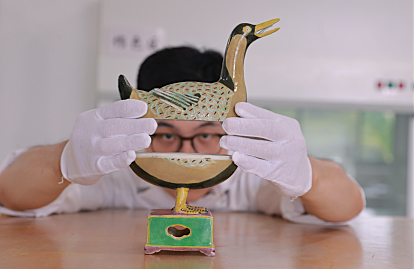
The gene bank has supported accurate reproductions of celebrated artifacts, such as the Yongle Blue-and-White Cup with Loop Handle, by supplying detailed information on form, glaze formulation and ornamentation. Open-source data has also inspired new cultural products, including items based on the Ming-era “Ducktor Sui” incense burner.
Weng said the goal is to make ancient knowledge accessible and relevant today. “By opening access to the gene bank, we encourage public participation and give new life to the timeless art of Chinese porcelain,” he said.
Disclaimer: Opinions expressed in the articles are of the authors and do not necessarily reflect those of the editors or publishers of Mumbai Messenger Newspaper. While the editors do their utmost to verify information published, they do not accept responsibility for its absolute accuracy.