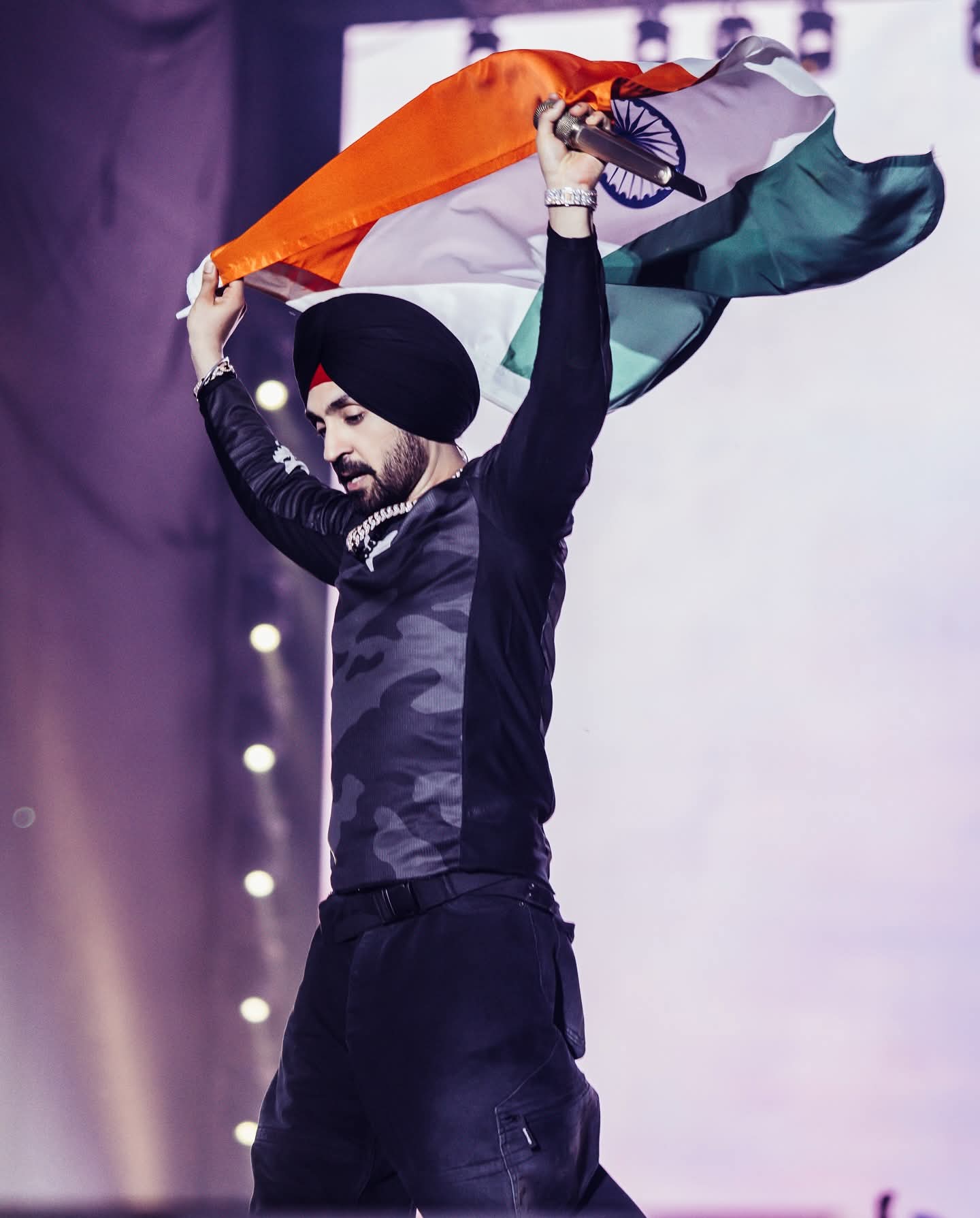
In a country where celebrity can crumble overnight under hashtags, Diljit Dosanjh remains oddly untouchable. He’s not just a singer, actor, or style icon — he’s a living contradiction: goofy yet shrewd, local yet global, a soft bridge in an era that loves sharp walls.
And right now, mid-2025, he’s in the news again — not for a new banger or sold-out stadium, but because Sardaar Ji 3 — the third chapter in his cult comedy franchise — stirred a fresh backlash. Here’s the twist: the film hasn’t even released in India yet. It quietly dropped first in Pakistan and overseas — an unusual move that says as much about Diljit’s reach as it does about Punjabi pop culture today.
Old ghost jokes, new border anxieties, hashtags flying across continents — but if you know Diljit, you know he’s seen all this before. And you know exactly how he’ll handle it: a quiet Sat Sri Akal, a smirk, maybe a new meme tomorrow.
Roots: A Village Boy, A Mic, A Dream
Long before stadium lights and Bollywood sets, there was Dosanjh Kalan — a name that would mean nothing to Google Maps if it weren’t for this boy who sang shabads in his local gurdwara.
Daljit Singh Dosanjh — the world knows him as Diljit — grew up in a modest home. His father drove a Punjab Roadways bus. His mother, stoic and steady, raised him on prayer and mustard fields. Like every small-town kid with a dream, he first sang for devotion, not applause.
His early cassettes in the 2000s — Ishq Da Uda Adaa, Smile — didn’t scream global pop star. But they carried a raw honesty: village heartbreak, sly jokes, tractors, girls next door. That honesty stuck — no matter how big the beats got later.
Pop, Folk, Stardom: The Rise
When The Next Level (2009) landed, it felt prophetic. He was exactly that — the next level of Punjab’s folk scene. Tracks like Patiala Peg and Dil Nachda didn’t just fill marriage pandals — they rattled speakers in Brampton and Southall. He wasn’t singing to Punjab anymore; he was singing from Punjab for the world.
Unlike many regional stars who polished off their roots to “fit” Bollywood, Diljit did the opposite. He doubled down on the turban, the plaid shawl, the pind dialect — his brand was mitti. And the diaspora loved him for it.
A Punjabi Hero in Bollywood
The big test for any regional hero is Mumbai’s film factory. Udta Punjab (2016) was that test — a small-town singer playing a stoic Punjab cop opposite Shahid Kapoor, Alia Bhatt, Kareena Kapoor Khan. People doubted him. Critics wrote him off.
He won a Filmfare Best Debut instead — not just for himself but for every turbaned boy who thought Bollywood wouldn’t let him keep his accent, his look, his soil. Phillauri, Soorma, Good Newwz followed. He stayed an actor, yes — but never stopped being a singer first.
Meme King, Desi Bro
Part of what makes Diljit so bulletproof is how un-star he acts when the cameras are off. His Instagram? A mix of goofy memes, Kylie Jenner jokes, paratha stories, random Sat Sri Akals. He’s not a PR machine — he’s your pind cousin who just happens to break Coachella.
His “ordinary boy” persona is the tightest armor. He knows exactly how it makes him un-cancellable. He laughs at himself first — so you can’t laugh at him later.
The Farmers Protest: The First Big Crack
If there was ever a moment Diljit’s clean neutrality cracked, it was the farmers’ protest of 2020–21. Thousands sat at Delhi’s borders; Bollywood stayed politely distant. Not Diljit.
He flew to Singhu. Ate langar on camera. Gave sharp Punjabi clapbacks to Kangana Ranaut that became folk legend overnight. He was called “anti-national,” “separatist” — all with zero proof. His response? A quiet Gurbani verse, a new track. He knew the people would see through the noise — and they did.
Sardaar Ji: A Franchise and a Folk Myth
Back in 2015, Sardaar Ji was a mad bet — a supernatural village comedy with Diljit as a ghostbuster in a turban. Pure nonsense, pure joy. But it worked. It was goofy and so deeply Punjabi that fans in Lahore pirated it before the official DVDs hit Chandigarh.
Part 2 followed. And now Part 3 — nearly a decade later — shows how his art crosses borders even when politics tries to draw new ones.
2024–25: The Backlash — Before India Even Sees It
This time, the script stayed true to the old vibe: ghosts, village superstitions, cheeky Indo-Pak jokes that every Punjabi uncle has cracked for decades. But now, the internet is a different beast. The film released abroad and in Pakistan first — and clips were plucked out, hashtags trended.
Some Pakistani influencers called him “insensitive.” A few diaspora celebrities joined in. Some Indian right-wing voices gleefully pounced: “Look, even they hate him. Maybe stay in your lane.”
Meanwhile, fans at his overseas shows posted reels dancing with him mid-controversy — proving once again that for ordinary Punjabis, a good beat beats a hashtag any day.
Who Stood Up for Him?
This is where India’s paradox shines. BJP leaders in Punjab defended him: “He’s Punjab’s pride — a bridge, not a border.”
Congress leaders like Sidhu called it “manufactured noise.” Some Pakistani Punjabi musicians privately backed him — they know the ghost jokes aren’t the enemy.
Because if Diljit has taught us anything, it’s this: when an artist belongs to mitti, he can’t belong to any single side.
A Boy Who Won’t Be Spooked
It’s poetic — a ghost comedy stirs real ghosts of border politics. But Diljit’s entire charm is that he can’t be spooked.
He won’t issue a desperate apology. He won’t fire off dramatic press notes. He’ll drop a new devotional single, smile at the noise, maybe troll himself on Instagram tomorrow.
Because for him, Sardaar Ji 3 is another love letter to the pind — mischievous, earthy, refusing to bow to a climate that loves to dissect jokes with a magnifying glass.
The Fans Have Decided
And the fans? They’ve already decided. The same Sardaar Ji 3 screenings abroad are sold out. Videos of Canada aunties dancing at his shows get more shares than boycott hashtags. The real Punjab — the global Punjab — has no appetite for digital rage that evaporates in 24 hours.
Soil & Soul: Where He Goes Next
Mid-2025: Diljit is still the same. A global Punjabi star who won’t ditch the local boy. A Bollywood hero who won’t let Mumbai polish off his accent. A meme king who knows a joke is just a joke, even when trolls say it’s war.
He’ll keep singing about tractors and heartbreaks, drop a goofy reel tomorrow, maybe drop a ghost joke in Sardaar Ji 4. Because the pind always outlives the noise.
A Soft Bridge No Border Can Close
Diljit’s journey says more than any op-ed ever could about our messy subcontinent. While flags clash and hashtags bark, an ordinary Sardaar Ji shows us how much we still crave soil, soul, and a shared dhol.
He’s not naïve — he knows he can’t heal Indo-Pak tensions with a pun about ghosts. But he also knows that music does what ministers can’t: pull people into the same room to laugh, dance, and remember that mitti is thicker than hashtags.
A Final Word: Sat Sri Akal, Sardaar Ji
If you want to understand the new Punjabi dream — equal parts tractor, ghost joke, stadium mic, and Gurbani — watch Sardaar Ji 3. Watch the controversy come and go. Watch Diljit grin through it, turban tied tighter, pind always in his pocket.
Because the boy from Dosanjh Kalan never left. He just brought the whole village with him — from the gurdwara mic to Coachella lights, from farmers’ protests to ghost comedies that rattle hashtags but not his heart.
The boy can’t be boxed in. Neither can the mitti.
Surjitt Sahani