By Li Xinshu
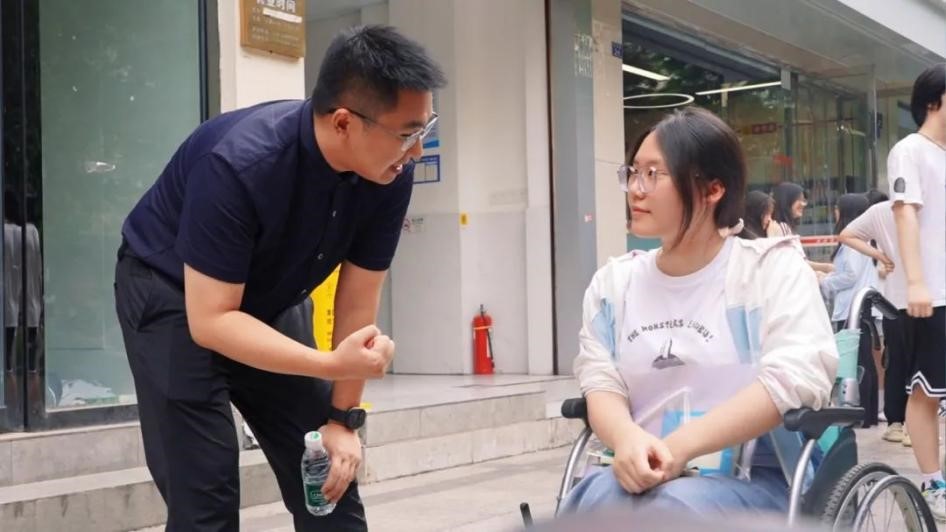
Amid the 2025 national college entrance examination—commonly known as gaokao—moving scenes of quiet resilience unfolded across China, from Suzhou in east China’s Anhui province, where Wang Ziwen, a student with osteogenesis imperfecta (brittle bone disease), was gently assisted into the exam hall, to Ziyang in Sichuan province, where Jiang Xintong, paralyzed from the waist down due to myelitis, arrived 30 minutes early via a specially designated access route, and to Shenzhen in Guangdong province, where Chen Xinhe—the only fully blind candidate in the province—sat for his braille-based exams with the support of special education teachers, a counselor, and medical staff organized by the test center.
These vignettes are emblematic not only of individual determination but also of China’s expanding efforts to make education more inclusive and equitable.
In recent years, systematic measures have been adopted to support candidates with disabilities. Blind examinees now receive 150% of the regular exam time, while students with hearing impairments are allowed to use hearing aids or cochlear implants. Those with severe writing difficulties or upper limb impairments may receive a 30% extension in exam time.
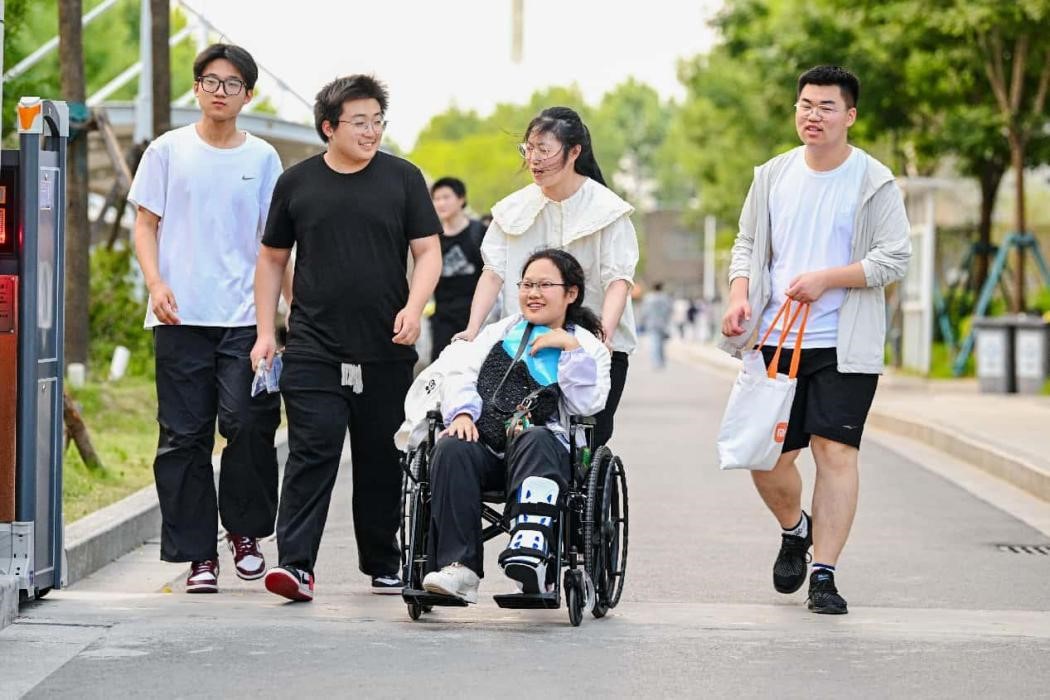
Students help push their physically challenged classmate out of an exam venue in Jiangsu province. (Photo: Chen Hong / People’s Daily Online)
In 2025, over 14,000 candidates with disabilities received such accommodations—an astounding increase from just 100 students in 2012, marking a 140-fold rise in just over a decade. This reflects a deliberate and compassionate shift in education policy.
Often described as one of China’s most equitable talent selection systems, gaokao is deeply rooted in principles of fairness and meritocracy. Its legitimacy stems not only from rigorous procedures and transparency but also from its growing inclusiveness. For many disabled candidates, it represents more than a test—it is a gateway to hope, dignity, and opportunity.
The concept that the right to survive and develop is fundamental has been central to China’s expanding public service frameworks. With rising national prosperity and improved healthcare and welfare systems, the foundational needs of people with disabilities are increasingly being met. The focus has now shifted to higher-order goals—education, employment, and self-realization.
The normalization of special exam accommodations—once seen as exceptional—is a powerful symbol of a society committed to enabling its most vulnerable members through institutional care and compassion.
As of 2024, more than 915,900 students are enrolled in China’s special education programs. With policies promoting access to assistive devices, large-print materials, home-based learning, and digital classrooms, special education is evolving. These initiatives are nurturing a generation of students with disabilities, empowering them to grow and thrive.
Beyond the classroom, efforts extend into broader aspects of life. In 2024, over 9 million persons with disabilities were employed across China, thanks to tailored job placement services and local employment initiatives. In healthcare, policies such as dynamic adjustment of care subsidies and expanding access to inclusive insurance programs are enhancing the lives of those most in need.
Together, these initiatives form a robust network of support—spanning from education to employment and healthcare—underpinning a more inclusive society.
Through sustained efforts to make public services more equitable, China is working to ensure that every individual, regardless of physical ability, has the opportunity to contribute to and benefit from national development.
Disclaimer: Opinions expressed in the articles are of the authors and do not necessarily reflect those of the editors or publishers of Mumbai Messenger Newspaper. While the editors do their utmost to verify information published, they do not accept responsibility for its absolute accuracy.