By Wang Junling
In the quiet countryside of Lower Saxony, Germany, homeowner Hoffmann found a smarter way to manage his large lawn. After researching various robotic lawn mowers, he chose one from Chinese brand ECOVACS. “Their route planning system stood out—it doesn’t just move randomly but covers the lawn systematically,” he said. “It’s efficient, and my wife’s thrilled I’m no longer spending every weekend mowing.”
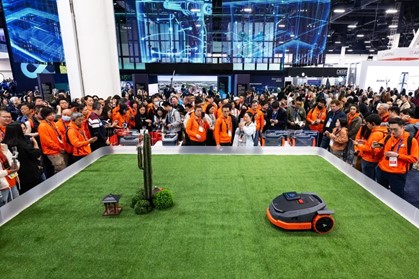
Hoffmann’s story is one among many reflecting a global shift: Chinese robotic lawn mowers are rapidly gaining popularity across Europe, the United States, and Australia. Brands like ECOVACS, Segway-Ninebot, Greenworks, Daye, Anker Innovations, and Worth Garden Products are reporting substantial growth overseas, with smart mowers emerging as a key driver.
“In suburban regions with low population density, homeowners often have large yards, making manual mowing inefficient and costly,” explained Zhu Fanghao, Senior Vice President at Anker Innovations. “Smart robotic mowers offer real savings in time, money, and effort.”
These mowers are designed to handle lawns ranging from 200 to 4,000 square meters and easily navigate slopes, flowerbeds, swimming pools, and trees. With outdoor aesthetics becoming a crucial component of property value in many developed countries, robotic mowers are entering a mature and loyal consumer market.
Growing global demand is fueled by aging populations, increasingly busy lifestyles, and a desire for low-maintenance outdoor living. “Electrification, smart automation, and low-carbon operation are the future of lawn care,” said Wu Junliang, General Manager of Shanghai Worth Garden Products, which is currently scaling up operations in the U.S.
According to forecasts, the global robotic lawn mower market is expected to reach $4 billion by 2028.
Chinese brands are thriving in this space due to their strong industrial ecosystem and efficient supply chains. “We’re seeing major advancements—like the shift from traditional boundary wires to LiDAR-based navigation and intelligent automation,” Wu said.
User reviews on platforms like Amazon highlight their popularity: terms like “easy to install,” “accurate obstacle avoidance,” and “top-tier performance” frequently appear. One user, A.T.K., noted, “With Anker’s eufy E18, there’s no need for perimeter wires. It expands zones automatically and even avoids mole holes. I think the software updates weekly!”
Chinese innovation in core technologies like LiDAR, multimodal control systems, and precision motion control has transformed user experience and driven down costs. Smartphone apps now allow users to remotely control mowers, schedule tasks, monitor real-time status, and receive alerts—bringing a new level of convenience to lawn maintenance.
“Accurate positioning, smart algorithms, and real-time obstacle detection are central to creating a fully autonomous mower,” said Ying Xinsen, director at Safun, a leading Chinese garden tool manufacturer. “China now leads in many of these domains.”
Additionally, China’s strong cross-border e-commerce platforms like AliExpress have made it easier for manufacturers to tap into global markets. Streamlined logistics, simplified transactions, and increased exposure have helped brands grow rapidly and build international recognition.
Experts see the rise of Chinese robotic mowers as part of a broader trend: Chinese manufacturing moving up the value chain, from volume to value. As the global economy grows more interconnected, the success of Chinese robotic mowers is just one sign of more “Made in China, Sold Worldwide” stories to come.
Disclaimer: Opinions expressed in the articles are of the authors and do not necessarily reflect those of the editors or publishers of Mumbai Messenger Newspaper. While the editors do their utmost to verify information published, they do not accept responsibility for its absolute accuracy.